Landscapes & Nature
Southern Central Massif
France

causses-cevennes.com

>
Architecture
Art & Culture
Enterprises
Fauna & Flora
Geology
History
Hiking
Links
Real estate
Regional products
Roadmaps
Tourism
B&B
Chambres d'hôtes

B&B Gîtes d'étape

Campsites

Hotel-restaurants

Holiday cottages
Regional products

Sportive activities

Skiing Southern France

Alternative holidays

Art & culture

Small business

canoeing
Gorges du Tarn

1 day or holiday
tarn-canoe.com

Old
Postcards

Barre
des Cévennes
Bédouès
Causse
Méjean
Corniche
des Cévennes
Florac
Ispagnac
La Malène
Mende
Meyrueis
Mont
Aigoual
Montbrun
Le
Pompidou
Le
Pont de Montvert
Portraits
Quezac
Le
Rozier
St
Etienne Vallée Française
St.
Germain de Calberte
St.
jean du Gard
Ste
Enimie
Ste
Croix Vallée Française
La Vallée Française
Les
Vignes

causses-cevennes.com

|
|

|
Traditional
architecture Southern Central Massif
Cevennes National Park
Cevennes, Gorges
du Tarn,
Causses, Mont Lozère
|
Limestone
|
Slatestone
 |
|
Granite
 |
|
Introduction
interesting and varied traditional architecture in this
amazing beautiful area between the Massif Central and the Languedoc plains
bedrock
:determines
the form of landscape and its architecture
Here reigne three
types of rock : limestone, schist and granite.
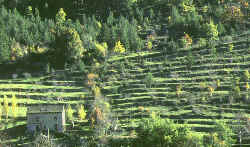
All over these rural
rrough region we find traces of human
activity
in between wide skylines and deep valleys.
The architecture reflects the needs and lifestyles
of its inhabitants and their response to the natural environment. It differs according to
the natural materials available locally and the history and personality of each region.
Before looking more
closely at the traditional architecture of each of the three regions - the
limestone Causses, the slatestone Cévennes and the granitic Mont Lozère - we
should mention certain features common to all of them.
Common
characteristics.
The homogeneity of the
traditional architecture is a product of the physical restrictions imposed by nature,
including a relatively high average altitude and a harsh climate. Travel is difficult and urban centers are far away. Soil quality is usually
poor except in some valley bottoms which have been covered with with more fertile
sediments.
In this hostile milieu people have
learned to construct buildings for themselves, for their livestock and to store their
crops, out of local materials alone.
They build their houses on land of no agricultural value, in most cases on rock in order
to have a solid foundation and facing the sun; in the Cévennes, however, this is not
always so.

|
The main
living-room of the home, which also serves as the kitchen, is protected from
extremes of temperature by a windowless wall or is cut into the rock.
The chimney is always set against a
gable wall, with the opposite gable separating itself from the stable or workshop. |
The entrance
and one or two small windows are placed in the sunny facade. The area above the kitchen is
used for sleeping or for storing hay or other things. The roof is supported by
powerful beams or a stone vault strong enough to withstand heavy snow and at the same time
insulate the house.
In all three regions the rearing of
livestock was the main source of income in an economy based on self-sufficiency, seasonal
work in a neighbouring region and the exchange of goods. The animals were housed
immediately below or adjacent to the living quarters, with their forage stored close at
hand.
An increasing population and
changes in farming practices made it necessary to expand: new buildings were added ine
every possible direction, sometimes eventually forming an inner courtyard, which had the
advantage of providing extra protection.Traditionally the buildings are of local stone,
quarried if possible on the spot, and these materials determine the style of the
construction and the techniques used.In areas without timber the floors and roof are
supported by vaults.
The walls are thick and are composed of two outer surfaces held together by big stones
called 'boutisses' which traverse the wall, the space between being filled with rubble,
sand or clay or, more recently, with mortar.
The
lintels of the doors and windows are of stone.The age of a building is hard to determine
because the stones and even the timber (when timber is used) were employed again and again
with techniques and building styles that have hardly changed for centuries. Nor are
the personal touches of each builder easy to interpret. |

|
The layout of the
buildings is the result of a long history of adaptation that lasted until the beginning of
the twentieth century, when farming started to decline and many families left the land.
Fortunately, this
heritage is now being restored with a new respect for these monuments of a distinct social
and technical culture. 
Choose now please one of the
three areas
© 1998 -2008 causses-cevennes.com - lozere.net
- mentions
légales -
Agence
la Bastide -
creation-internet-site.com
|