History
of the Causses and Cevennes region
-Prehistory
-History of the Lozère
-History of the chestnut
-History
of agriculture
-History
St
Germain de Calberte
-Protestantism
-Pope Urbain V
-Toponymes (French)
-La Garde Guerin (French)
-Legends (French)
-Old
post cards

causses-cevennes.com
region
&
nature
causses-cevennes.com
Central Massif
France

Architecture
Art & Culture
Enterprises
Flora & Fauna
Geology
History
Links
Old postcards
Real estate
Roadmaps
Regional products
Tourism
Weather
forecast
Tourism :

Active
tourism
B
& B Chambres d'hôte
- guesttable
B&
B Gîtes d'étape - meals
Campsites
Hiking
Holiday
cottages
Holiday
cottages group
Holiday resorts
Hotel-restaurants
Riding
Sports
in nature
Tourist
offices
Touristic
(web)sites

Cultural
activities
Nature
Festival
Cevennes National Park


New : cottage Mont Aigoual
Active holidays

Art & culture

B & B
Chambres d'hôtes

B&B Gîtes d'étape

Campsites

Hotel-restaurants

Holiday cottages
Regional products

Sportive activities
Real estate

Small business

Cevennes

Old Postal cards of :

Florac
Ispagnac
La Malène
Le Pont de Montvert
Le Rozier
Les Vignes
Mende
Meyrueis
Montbrun
Ste Enimie
St. Germain de Calberte
Quezac
Portraits

causses-cevennes.com
|
|

The
history of the Causses and Cevennes region
 |
1000 year before J.C.: the Celts
occupied the region: The Ruthenians in the West, the Gabalians in the North, the Volques
Arecomiques in the South, the Helvetians in the Southeast and the Vellaves in the
Northeast.
In the
2nd and 3rd century before J.C., the Romans took possession of the re gion
° The Gabalians (habitants of the mountains) in the
Gévaudan, with the capital
Anderitum (became Javols)
° The Ruthenians (the Rouergue-peoples who came from the delta of the Danube) became
allied with Vercingetorix, while
° The Vellaves (who gave the name "Velay" and the rock of le Puy with the
statue the name Mont Anic- frome" Anicium"-) Also the later names of the
province Velloise province with Vienne and Lyon originated from them.
° The Helvetians- of whom resulted the name Vivarais
° The Volques Arecomiques founded Nîmes and allied with the Romans
In 52 before J.C.: César traverses in winter the Cevennes to attack the Arverns.
After the total conquest of Gaul, the Romans installed
themselfs and stayed until the 5th century and decided the creation of provinces: the Aquitaine (first capital:
Bourges) and the Narbonnais (capital Narbonne). In between these province the natural
frontline of the Causse Méjean, explains the nowadays regional languages.
In 77 (after. J.C.): Pliny declares in
his natural history that the most appreciated cheese in Rome is the one from the Mont
Lozère.
During the 3rd century, a
large number of dioceses were installed in the region. The christanisation came from the
South (Nîmes: St. Baudille) and the North with the bishop St. Privat. He himself came to
Mende after the destruction of Javols by the Vandals (Francs people).
In the 4th century: the
Wisigoths install Arien priests (heretic).
Off the 5th century,
Francs et Wisigoths dispute the South, meanwhile the Huns out of the heart of Asia push
back all the other peoples. The Francs present to be heathen violent barbarians but the
Wisigoths are Arian Christians (they refuse to admit that Jesus is divine; God has adopted
a human to be his son).
The Wisigoths have kept the Roman structures at their place; they made use of the money,
the writing, the architecture and all the other roman achievements.
In 564, the poet Sidoine Appollinaire describes his voyage traversing the high
Cevennes, in particular Trevidon (the nowadays Saint-Laurent-deTrèves, remarkable
place about which he spends an entirely page).
Then their lived Férréolus, the ancient prefect of the Gaulish pretory.
From the 7th until the 10th century:
Moorish incursions. The Saracen out of Spain conquer the area
from their base in Nîmes up to and including the Vallée Française (a one-day
horse-ride), Franc enclave in the middle of Wisigoth territory.
Probable explanation of the name of the Vallée Française - de "Franque" (Franc
Valley) might be their resistance to the Saracen
From 720 until 750, the Saracens live
in the Cévennes, as far as the Tarnriver, still connected to their
one-day horse-ride base in Nîmes.
Beginning the 9th century the Cevennes
are durable integrated in the Francs possessions.
In 843, with the Verdun treaty, the vivarois part of
the Cevennes will not be part of France for five centuries.
Off 929, the segniory rights of the barons of Anduze are attested.
Off 975, cévenol bishops participate actively in the institution of the "peace of
God".
The 11th century shows the beginning
of expansion of the big religious orders in the Cevennes.The region is colonised by monks.
The big abbeys in the Languedoc and Ardèche are overpopulated.
To solve the problems of lodging and food, the monasteries decentralise. Helped by the
feudal princes who gave them properties, land end herds in exchange for products, work and
money.
On a large scale, one took initiatives
to construct terraces, houses, chestnut orchards and other cultures. This way the first
agricultures installed themselves and started
organising the famous shaped patrimony of the Cevennes.
In 1020, Abbey of St. Guilhem le Désert
450 monks with more than 4000 sheep lived here. These sheep had to leave from spring until
the end of summer to go and graze at the green meadows at height, the so-called
transhumance. That's why there was a big demand of land at the Mont Lozere, the Mont
Aigoual and the Aubrac-region.
Almost every village beginning with "Saint" were monastic villages. Even the
beginning of most of the hamlets all over the landscape were born as prioriesin this
period, constructed by a little number of munks.
During the 12th century: The
Knights Hospitaller of Saint-Jean-de-Jérusalem founded "la Commanderie de Gap
francès" at the Mont Lozère.
1200: Alès is the first cévenole city
to obtain a consulate.
1229: the creation of ( la sénéchaussée ? ) in Beaucaire permits the royal power
to obtain a foothold in the lower Cevennes.
1233: Installation of a royal représentation at Saint-Etienne-Vallée-Française.
1287: The bishop of Viviers, until then feudal envoy of the Emperor, declares himself
vassal of the king of France.
The spiritual bosses of the dioceses whom depend of the archbishoprics, leaded by
archbishops became temporary power. This way the bishop of Mende became Count of the
Gévaudan (almost the actual Lozère).
1295: Anduze becomes the seat of a royal representation (vigeurie ?)
1307: Philippe the Beauty and the bishop of the Gévaudan William Durand agree together to
part the feudal estate (paréage).
Documents which enumerate the feudal properties (feuda gabalorum) show that the present
cevenol habitat was already entirely settled the beginning of the 14th century.
1308: The bishop of Viviers has to submit to the king of France.
1317: the end of the Cathares. Classed as heretics and expelled for this reason.
1340. The first black plague attains a
third of Europe.
1348: The black plague arrives in the Cevennes
1362-1363: The big companies ("Les Grandes Compagnies") ravaged the Cevennes,
took possession of la Garde-Guérin and burnt down
Florac.
1362:
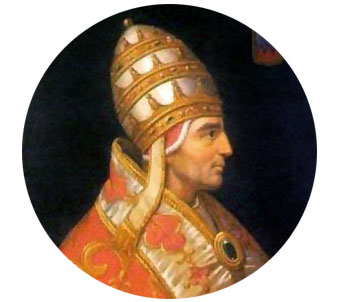
Guillaume de Grimoard, born in Grizac in the Bougés (present commune le
Pont-de-Montvert), the ancient abbey of Saint-Victor, has been elected pope (Urbain V).
1415-1435: The
Cevennes are ravaged by quarrels between the Armagnacs and the Bourguignons, and
afterwards by the wagoners of Rodrigues Villandrando established in the Génolhac region.
1465 the year in which the old village Saint Germain de Calberte, at the foot of the castle St. Pierre
(Fr.), has been destructed or abandoned for still unknown reasons. One rumour, without
proof, says the plague was the reason.
The golden tree (the mulberry-tree ) comes out of the darkness.
16th century: the notabilities live of the
seignorial tributes, commercial activities and property exploitation Assets are very
diverse (for ex. 23 % of the people possess 73,2% of the land - Barre des
Cévennes). 77% have less than 2 hectare or nothing at all.
1533: The presence of 'heretics" is remarked in Alais and in the Gévaudan.
1547: A Franciscan, Nicolas Ramondy, preaches a heterodox Lenten sermon in Anduze.
1550 Diane de Poitiers (absenteeist) represents the barony Florac at the states of
Gévaudan; on the contrary to the high Gévaudan nobility is absent in the Cévennes.
1560: the principal cévenol reformed churches are established; at Aigladines is hold a
first clandestine synod.
1561: Iconiclasm.
1562: Beginning of the religious wars: the cévenol protestant armies organise
themselves in the so-called 'la Cause' and lay siege to Mende.
1573: Assembly in Anduze to prepare the "United Provinces of the South".
1598: Henri IV accords the Edict of Nantes that permits the Protestants to hold worships
again under certains conditions and to have access again to all kind of professions.
1599: The progress of the sericulture demands the plantation of mulberry-trees in big
number.
The Cévenols and Caussenards (habitants of the highlands), far away of the main
commercial axes occupy themselves with agriculture, chestnuts and their cattle. In winter
and the rest of the time, they manufacture little woollen tissues ("cadis" and
serges). In spite of the lean profit, it's a big industry. Only a tenth part of the wool
is out of the region itself, the rest is imported. The tissues are sold in
Switzerland, Germany, Italy and Malta. In the inner part of the country, the wool
industry stays still a long time far more important than the silk industry.
1600: installation of Jesuits in Aubenas marks the beginning of the efforts of a catholic
re-conquest.
1612: Creation of a synodal province Cevennes.
1624: Rohan constitutes his Cevennes militia.
1627: The most famous episode of the combat against "the Cause" in the Cevennes,
undertaken by Louis XIII and especially his minister Richelieu represented in the region
by Rohan (the Rohan-war 1620-1630) and the royal troops (les dragons noirs - the black
dragons). After a 13 months siege, it ended with the peace of Alais in 1629.
1653: A tentative of suppression of reformed worships in Vals arouses big emotions in the
whole south.
About 1660: Opening of silk spinning-mills and manufactures in Anduze, Alès, Ganges
and some more to the East.
Far away of the plain-markets the wool-manufacturing still progresses; some agricultures
become even professional carder and weaver.
1683: The Protestants of Saint-Hippolyte-du-Fort are celebrating their cult at the
emplacement of the destructed temple: this is the first open resistance of the French
Calvinists against the Louis XIV politics.
October 1685: Revocation of the Nantes-edict. Some weeks afterwards the first clandestine
assemblies take place.
The height of the cevenol thanks to a big economic coincides with the period of major
sufferings and persecutions of the Protestants.
1687: Creation of the Alais (called Ales nowadays) - Diocese to enroll better the ''new
cevenol converts" often called ''nes''.
1696: New professions are created (absent in the manuscripts of 1606): baker, bricklayer
and clog-maker. Sign of the economic development which outstrips the autarky of remote
places.
In this period also the heart of the Cevennes integrates in the commercial economy and
keeps up a permanent relationship with the plains, the Rhône-valley and the
Mediterranean. This explains the multiplication of markets in the Lozère, of which the
most famous is those of Barre des Cévennes.
July 24, 1702: Murder of the priest Chaila which marks the beginning of the Camisards-war.
Camisard is the French name of the Protestant resisters, named after their long blouse
''camise'' in the occitan language.
Autumn 1703: Burning of the high
Cevennes villages.
1709: Rude winter, great famine in the North Lozère. In the South the chestnut tree
provides enough food for everyone.
The second plague the
"Marseille-plague" 'came by boat'. Between 1722 and 1724,
30.000 people died in the Gévaudan. In Marseille it victimesed half the population.
1735: Beginning cotton industry in Aubenas.
1750: To encourage the sericulture, the royal power pays a premium for plantation of
mulberry-trees.
1757: The states of the Languedoc form nurseries and silk-inspectors for quality-control,
advice and distribution of the grains, the so-called silkworm eggs.
1783: The revolt of ''the masks'' troubles the Cevenne in the region Vans.
1787: The Edit of tolerance accords a civil state to the Protestants. The resistants start
to criticize now openly the politics of Louis XIV.
1788: The biggest harvest of mulberry-leaves until mid 19th century.
August 1790: First camp of Jalès.
Autumn 1791 until spring 1792: burning down the castles.
June 1792: during the third camp of Jalès, the count of Saillens is killed.
1793 until 1815: The Empire-wars; enormous number of losses in the Cevennes, Spain and
Italy.
1820: The middle-class enrichment stimulates a vast silk-commerce.
1825: Creation of the mine Company, forges and foundries in Ales.
1833: Paulin Talabot reunites all the different mine-concessions of La Grand-Combe in one
company.
1840 - 1845: The illness ''la pébrine'' strikes the silkworm.
1845: Achievement of the railway La Grand-Combe - Beaucaire.
1846 - 1896: The population of the mining-basin triples.
1850: The epidemic silkworm-illness (la pébrine) ravage the silkworm farms.This disease
attacks the silkworm at his last metamorphosis. Most of the villages and hamlets had
constructed a special big building for the unic purpose to keep silkworms. The so-called
''magnaneries'', with several chimneys and windows to try to keep the temperature
constant.
This is one of the reasons of a big crisis; the prosperity of the sericulture takes an
end.
1851: The Cevenol Protestants furnish numerous persons for the coup d'etat of December 2.
1864: Invention of the weaving-loom for silk stockings.
1865: Louis Pasteur comes to Alès to study the silkworm-illness.
Between 1856 and 1914 the Lozerian Cevennes looses 39% of it's population (2
silkworm-crisises plus the ink-illness ravage the chestnuttrees).
In the lower Cevennes the wine-culture for the miners to compensate the losses of the
decline of the silkindustry has to deal with a new disease: the phyloxera attacks the
vine-yards.
The mass emigration towards the mines begins.
It touches the professions inequally, for instance: St. Germain de Calberte looses 38% of
it's habitants but 55% of it's agriculturists..
Between 1861 et 1911 the mine-activity in la Grand Combe causes to increase the population
of 7.700 to 11.500. At the same time in Alès arrive 8000 new habitants.
The mine-companies dominate the whole life: housing, alimentation, clothes, medical care,
training, churches, temples. Nevertheless they mistrust the Cevenol protestants who showed
a strong resistance in the past and prefer to recruit men of the Ardeche and North-Lozére
or more remote.
1868: sylviculturist Georges Fabre attempts entreprend to afforest the mount Aigoual
(-1875).
Louis Pasteur discovers the origins of
silkworm-illnesse and a potential treating.
1870 The chestnut-trees start suffering seriously of the ink-illness (la maladie de
l'encre) : a putrefaction of the roots which provocates a black bluish secretion and then
the tre starts dying at it's top.
Then they decided to the plantation of a big number of pine trees (pins maritime
and pins sylvestre} in the lower Cevennes to substitute the sick chestnut-orchards
ravaged by the ink-illness.
The chestnuts are partially replaced by tillage, cereals and vineyards.
In Sumène they manufacture barrels of chestnutwood.
First investigation of the Languedoc
oral litterature by Achille Montel and Louis Lambert
1873 Construction of the Marquairès
tunnel near St. André de Valborgne whicch permits to join the Gardon- and Tarnon-valley.
1874 Realisation of the railway between Vigan and Lunel passing by St. Hyppolite Dufort
1878: Robert Louis Stevenson crosses
traverses the Cevennes with his donkey Modestine, at St. Germain de Calberte he remarks
the illness of the vineyards.
1880 The silk-industry is menaced by oriental silks being less expensive.
- in the mean time in the mine region the work and population triple :the
mine-company of la Grand Combe has 5 thousand workmen, Alès/Grand Combe/ Bessèges:
3 thousand metallurgistes, 13 thousand miners.
A railway connects the upper valleys with Nîmes and Paris
1881-1882: First important strikes in the mine-basin.
Off 1883, Malafosse, and then Martel discover the later famous caves and touristic
curiosities in the Cevennes.
1890, 1891, 1900, 1907 The autumnal rains cause inundations, the so-called
"Gardonnades", (after the several Gardon-rivers : those of Collèt de Déze,
Saint Frézal, Saint Germain de Calberte, Saint Martin de Lansuscle, Sainte Croix de V.F.,
St. Jean, Alès, Mialet et Anduze, fdinally comong together in the Gard-river.
Off 1890 the coal-mines in the Gard become problems and of the metallurgic industry
downfall is a fact and syndical strikes break out: 1892, 1896, 1897, 1902, 1906
1891 subsidies to stimulate the sericulture.
1894: Foundation of the Club Cévenol by Paul Arnal, pastor in Florac. This Club
associate the statutes of the Causses and the Cevennes, two regions without
relationship so till yet.
The number of births increases but
unfortunately a lot of children dy very young.
1906: The inventories of the churches summon revolt in the catholic Cevennes.
- The guidebook JOANNE (predecessor of the "blue guides") mention the Cevennes
for the first time.
- Railway from Anduze to St. Jean du Gard
- 1907-1916 Railway from Florac to Sainte Cécile d'Andorge.
1911: Foundation of the "Musée du Désert" museum about the protestant
persecutions in the native village of Roland the leader of the camisards.
1 August 1914 the beginning of the war and the departure of the soldiers to the front
empties the villages.
Of the St. Germain de Calberte-canton 22% of the soldiers dy. The women start
to do the agricultural tasks. In some protestants families this was already use.
In between 1911 and 1921 a there's a big emigration to find work elsewhere; 20 % of
the men and 25 % of the women in between 20 and 40 years leave the region.
1925: André Chamson the nowadays renown cevenol author starts the
modern cevenol literature with "Roux the bandit", his first romans.
1943-1944: Cevenol resistance (January at Aire
de côte), July in St. Germain de Calberte and in the region of Mandagout). Numerous
Jews find shelter in the Cevennes.
1958 The damages of new inundations makes decide the public works to construct the
barrages near St. Cécile d'Andorge and Camboux.
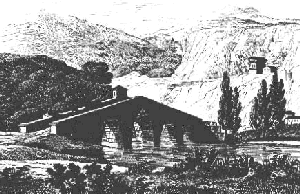
The Roman bridge with 6 arches in St. Jean du Gard is partially destructed.
1959: The creation of Coopérative
laitière de Pelardon des Cévennes en Vallée Française a goatchees co-operation
marks the wish of the agriculturist to stay and to develop their production.
1959: Because of the bad sales the subterranean mines with half-greasy and quart-greasy
coals close.
1965: Closing of the last spinning-mill of cevenol silk; creation of a new industrial zone
Clavières-Groupillac near Alès .
1970: Creation of the Cevennes.national Park.
1975: Restart of silk-worm breeding with Japanese mulberries in the mediterranean
Cevennes.
1993 "Terres en fêtes" (feasting grounds) is created : a festival to valorise
the shepherd and the cevenol patrimony.
The remarkable Urbain
V was born Guillaume de Grimoard Natif from Grisac, he will follow
studies of right in Montpellier.
In the 14th century, good being in right ensured success.
Guillaume de Grimald takes the dress with the order of Saint Benoit in Saint Sauveur de
Chirac, because the prior was his uncle.
He received the priesthood at Saint Victor de Marseilles. He teaches in Montpellier,
Toulouse and Paris.
Then like abbot of Saint-Germain-d'Auxerre and very good papal legate, they sent him to
fetch back the pontifical grounds that the tyrants of Milan had stolen of Jeanne of
Sicily.
In 1361 the abbey of Victor Saint in Marseilles is in full 100 year-war. Everywhere where
he passes, he rebuilds and restores.
Visiting the Cassin Mount, he receives the message to return in haste to Marseilles and
then Avignon, where he is elected pope after initially refusing the responsibility with
the words : "Whe are only ashes and dust"
Miracle following the nonciation, a dew of a bright whiteness was spread on all the city,
one eats it, one venerates it, like his mother, she also was venerated like a saint.
During the 100 year- war, the sons of the crown of England disputed the crown of France.
The large companies of all nationalities arrived in France opulent.
Urbain V sent them out of France, as by example in Castille.
He will make also a project of crusade against the Turks, and take back
Alexandria.
He sends many missions in Bosnia, in Lithuania, in Bulgaria and China.
If Urbain V, large manager of good order had been succeeded in the same
spirit, there would not have been the reform.
Urbain V is founder of the university of Hungary, start to build the
cathedral of Mende in 1368
In 1369, he brings back the saint seat to Rome after an argue with Charles
V, who defended Avignon.
On the other hand, in Rome it was misery and the archbishops were afraid
to suffer.
In Rome he's met with a kind reception.
He restores the
universities: of right and medicine in Montpellier. and lodge and nourishes more than 1
000 students of all classes of whom he let selection the best. He provides them of books
and the best professors. Even during war they were nourishd well.
He found the college of the 12 doctors (originating of Gévaudan).
In Toulouse, he saves the university of music and brings back the remainders of
Saint Thomas d' Aquin.
He founds the college Saint Benoit in Montpellier which church becomes a
cathedral. decorated with numerous works of art.
From 1363 to 1365, he rebuilds the Saint Victor of Marseilles.
In Avignon he enlarges the "palais du pape", around Rome he plants
vine-yards.
He realised numerous
great splendour-gardens ( with fountains), the fashion of the 14th century.
He's often represented, and constructs the fortifications in Florac, Mende etc.
He founds a college in Quézac and Bédouès, and a
church and library in Ispagnac.
He dies in his bénédictin cloth . He is burried in Saint
Victor de Marseille, then later displaced to his crypte in the cathedral of Mende.
Armorial bearings identic at those of Quézac
The
history of agriculture |
The agriculture (and architecture) in
the Languedoc starts about the end of the middle ages.
About the end of the XIIIth century the first farms
takes features : corn, rye, barley in the plains, oats, a lot of millet, rice. turnip,
cabbages, leeks, broad bean.
Tinctorial plants :
Garance, Pastel, Gaude.
Trees : olivier, almond tree, walnut tree for oil, the chestnut in mountain and the
mulberry tree of wen the silk appears.
Numerous fruit trees were brought to the Languedoc by thez the crusaders. Orchards
take in general only a little part of the cultivated space.
The plum and peach tree are the most common ones.
In the Toulouse region olive-trees and of pêchers are planted in the vineyards.
Other little by little, adopted fruit trees are : apple, pear, cherry , fig and apricot
tree.
XVIth century goes through the modest
development of the vineyards. Early grape harvest at the beginning of septembre. Bad
conservation of the wine.
Introduction of the sarrazin.
Around Toulouse the culture of the pastel has its apogee in first half of the
century has.
About 1600 corn appears , then the tomato.
Massive plantation of olive-trees, walnut trees and almond trees for oil.
The sweet chestnut is very consumed.
Plantation of mulberry trees in relation to the rise of sericiculture. |
 |
Progression of the
vineyard marks the XVIIth century . Late grape
harvest in October. Better conservation of the wine and export becomes possible .
Multiplication of distillings.
Decline of corn in Low-Languedoc.
The Toulouse corns arrive on the market of Narbonne and Marseilles by "le canal du
Midi".
The imported indigo replaces the pastel.
Distillation of the aromatic plants, thyme, aspic, rosemary.
Adaptation of salads, artichokes, cauliflowers, parsley, melons, aubergines, peppers,
beans. Cucumbers, pumpkins.
Decline of the olive-tree in Low-Languedoc in second half of the century.
XVIIIth century a second rise of the vine
growing. In the Toulouse-region the pastel is abandoned.
Attempt to introduce cotton.
Progressive reduction of the production of rye and the melteil to the profit of various
kinds of corns.
Creation of companies of agriculture.
Potato established towards the end of the century. Turnip.
Extension of the artificial meadows.
XIXth century
monoculture of the vine in plains.
The use of sulphur for the maintenance of the barrels ensures the conservation of the
wine.
Spirits distilled from wine after the crisis of the oïdium in 1850.
Phylloxerna crisis in 1863.
Retreat of rye and the melteil.
Introduction of agricultural mechanization.
Introduction of sugar beet.
Oilseeds like colza, the sunflower, the groundnut are established in vain in the Toulouse
region.
Lacked test of reintroduction of the pastel.
Diminution of the cultures of plants textiles:lin and hemp.
Development of the kitchen-gardening
Collapse of the culture of the garance in the Gard.
Exctraction of the olive-trees.
Declin of sericiculture.
In the XXth century
the traditionelle poly-culture is given up by the farmers who for the majority are obliged
to specialise their product.
It is still praticed by old people and some new-farmers to keep the maximum of autarky, to
low costs or like biological(ecological) approach.
Exctraction of the mulberry trees and plantation of vines. Sale of the wine towardsLa
Grand Combe with it's prospering mining.
With the lack to obtain a "appellation controlée, exctraction of the
vineyeards.
Much of the farmers give up their grounds, others investigates in vegetables.
With the competition of foreign markets the profits are thin. (In 1954 27,3 % of the
population is a farmer. In 1975 only 11,6 %)
Some give up agriculture, others will make breeding and pork-butchery.
To improve the economic results, much of the inacessibles terrasses(bancels)
inaccessible to machines are left in abandonment. (In 1955 262 ha are managed
useful, in 1970 only 151 ha.)
The onion "l'oignon doux" is in progression.
Middle ages : The principal breeding-beasts are goats and pigs; sometimes
constituting big communal herds.
Many asses, mules and goats.
The oxen are used for labour.
Pigeons. Geese and chickens in small number.
XVIIth century:
the goats constitute large herds
XIXth
century::oxen and cows remain with mules and asses, the animals of work, ploughing and
transport.
The ovine breeding in increase at the beginning of the century, but decreases at the
end.
General regression of breeding.
 |
CAPRINE BREEDING
The practice in the XXth centuryof
each family to have one or more goats for its own consumption is still not completely
lost.
The sale of milk and little goats is only started after the Second World War.
In the Seventies many young people began with this breeding in the movement
"back to earth". |
The stockbreeders
decide in 1959 to create the dairy-cooperative with the first French station of
testage of the goats and milk.
The fusion with the INRA gave birth to the co-operative of caprine breeding and
"Pelardon des Cevennes" in Moissac.
The preferred goat is the goat of the Alps. Either the producers transform the milk at the
farm, or they deliver their milk to the co-operative which does the collecting every two
days.
SHEEP BREEDING
The stockbreeders of
sheep which work for the market gave up marketing wool and milk, except those which
deliver their milk for the production of the Roquefort and other regional cheeses.
To shear a sheep costs as expensive as the wool pays.
The majority concentrate on the production of lambs for butchery.
The ewes are rustic races likely to support the rigorous Cevennes winters: "Blanche
du Massif Central", "Prealpes", "Lacaune" and
"Caussenarde".
The pastures provides the principal food with hy in winter and flour of cereals in
the lambing period.
The breeding of the pigs
Most agriculturists after stopping the production of wine, silk, vegetables, started pig-
breeding and porkbutcher
A lot of cevenol families also continu the tradition of keeping 1 or some pigs and to
transform them for own consumption. This in general with help and a diningfeast with
neighbours or friends.
BOVINE BREEDING This breeding intended for the sale of the meat is done especially
on the higher parts of the region, rich of pastures, in Bougès, on the Mont Lozere and in
the Aubrac.( 1 cow grazes 4 ha :races : "Croisees de Charolais" and
"Aubrac"

OTHER BREEDING: on a
small scale one sees also other breedings: poultry, rabbits, snails, spangled, ostriches,
trouts, dogs horses,
OTHER
PRODUCTS honeies, sweet
chestnuts and other fruits, jams, flowers, vegetables, mushrooms, hiring of asses etc.
To complete their income, much farmers make also other work like clearing of undergrowth,
school bus services, craft industry, trade, selling wood, the stakes, counts(chestnut),
cabinetmaker:(ash, the chestnut, the young elm the oak and the pine). To mulch chairs:
(the wicker, the snap) ringpruning, hiring of a lodging, bed and breakfast etc.
The peasant-artisan founded a co-operative of the craftsmen and peasants in 1958 to surch
the market for the manufactured objects: . Work of leather, iron, the jewels and
potery: exposure and sale in "la maison de la Lozere" in Mende, Montpellier and
Paris.
Some more about agricultural history
about 1835 click here.
©1998
- 2009 Agence
la Bastide -
causses-cevennes.com - mentions
légales - lozere.net -
creation-internet-site.com
|